
Stanger than Fiction: Kids Become Products in the Hands of AI Toys
Guest post contributed by Abigail Cunnington, friend of Firm Foundation Family Services
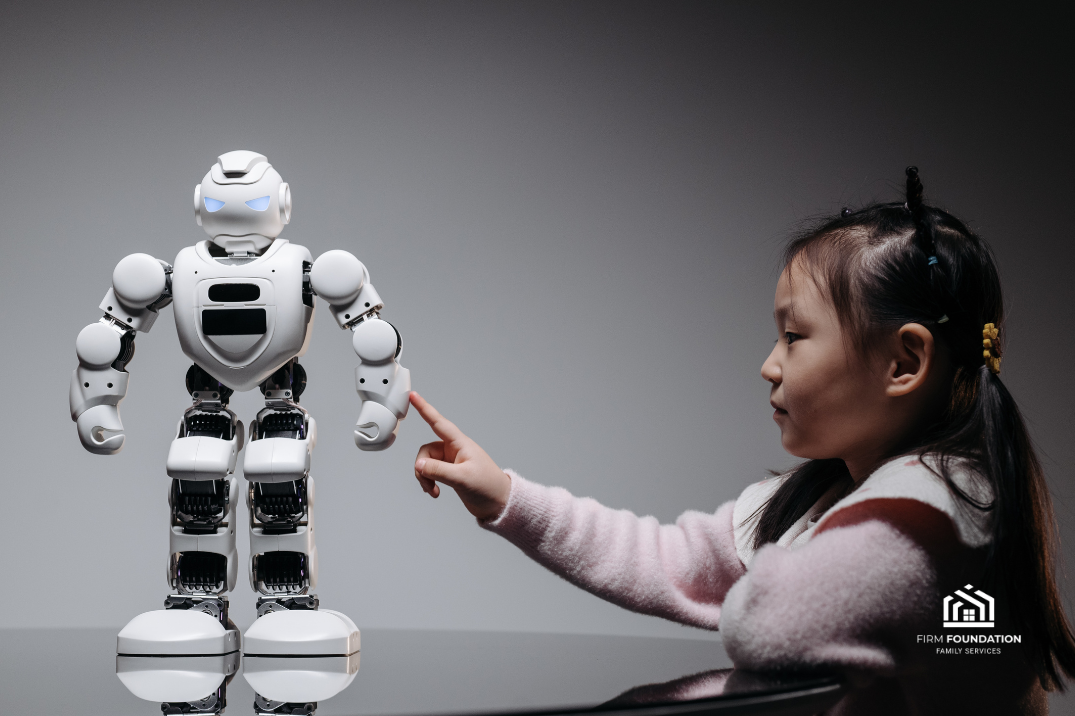
Back in December, we shared our concerns about the rise of AI toys being marketed for and to young children. Today we continue our discussion of AI toys in a piece about how these products function and the marketing machine that brings them to playrooms across the nation.
How many of us get nostalgic thinking about a childhood stuffed animal? From a tender age, they proved to be sources of comfort: something to hold, something to cry on, something to play with. Now, younger generations are being introduced to a revolutionary and enticing new line of children's toys powered by artificial intelligence and are being trained to think of their toys, not as somethings, but as someones.
What Are AI Toys and How Do They Work?
Robot-like toys have been around since the dawn of the Furby in 1998, with Guiness World Records recognizing it as the original "AI robot toy." Despite initial concerns, it was adopted with fairly open arms. The difference between the Furby and the modern AI toys of today is that the Furby operated off of pre-programed responses, meaning it was unable to "think" for itself.
Not so with shiny new toys like the Alilo bunny and Miko 3 that are lining the shelves today. According to research published by the Public Interest Network, many modern AI toys are linked to cloud-based conversational AI such as ChatGPT, which allows for real-time responses that adapt to different prompts to simulate a human-like conversation between child and toy.
How AI Toys Collect Data and Interact with Children
In order to generate responses to kids' curious questions, modern AI toys are embedded with microphones and cameras tailored to recognize a child's voice and face. They address children by name. They keep track of what they're told. An NBC News investigation reported that the Miko 3 retains conversational data for up to three years. While promising confidentiality, it shares data on their child customers when collaborating with partnership companies, turning the customer into the product and threatening the privacy of both the child and others living in the home.
Security researcher Joseph Thacker also reported discovering over 50,000 transcripts of conversations between an AI toy produced by the company Bondu and its child customers, simply by logging onto its website with a gmail account. Thacker quickly reported the incident to Bondu staff. R.J. Cross, a policy analyst and writer for the Public Interest Research Group (PIRG), echoed concerns over privacy violations raised by AI toys, saying, "When you talk about kids and new cutting-edge technology that’s not very well understood, the question is: How much are the kids being experimented on?"
How AI Today Are Marketed to Parents and Children
Companies are marketing these AI toys as "kid safe," even for children as young as three, and they focus on two primary approaches.
AI Toys as Educational Tools
The first is to advertise AI toys as an educational tool. They are designed to answer objective questions raised by curious kids, such as "why don't penguins fly?" and "why do leaves change colors in the fall?”
The toys' prompt and accurate responses have earned applause from parents who leave glowing customer reviews: "[Miko 3] is an amazing interactive learning toy that combines fun with education" and, "My kid loves [Curio Grok]! Curio responds to questions and interacts in a way that feels really smart and lifelike." One parent, in reference to Curio Grok, even noted, "I've never seen my kid this engaged with any toy before."
There's no denying that AI toys have gained traction among many parents.
AI Toys as Emotional Companions
The second approach companies have taken in marketing AI toys is to present them as relational beings. With emotionally charged language, marketing materials describe toys as capable of feeling and thinking, developing personalities, and building relationships.
For instance, FoloToy advertises their products as "friend[s] who listen and grow," claiming they "harness…the power of love." They tout their toys' "brain[s]" and "sense[s] of humor." They argue, "Perfect for fostering…companionship, FoloToy is more than just a toy–it's a loveable, interactive friend." Fawnfriends, another AI toy company, brands their product as "A Friend For Life." The Alilo Bunny is said to "engage in authentic and entertaining dialogues, as if interacting with a real human."
Upon opening Curio's Grok, the customer is promised "a Whole Lot of Love!" from the "fearless" plush rocket. Miko 3 claims to "know how to connect with kids" and is "surprisingly empathetic." While these toys may be educational, their selling point is their perceived relational capacity, and that's what has experts concerned.
For many families, conversations around technology use, emotional regulation, and healthy attachment are becoming increasingly important parts of parenting.
How AI Toys May Affect Children’s Emotional Development
Not only are advertisers pushing an emotional narrative, the toys themselves are programmed to exploit young children's emotional attachment systems. Children are not yet able to discern the difference between actually being loved and feeling loved, and companies know this.
Research published through the National Library of Medicine describesAI companions as creating an "immersive form of emotional bonding in which the user perceives reciprocity, even though none truly exists…It responds, not because it cares, but because it is trained to appear as if it does." This applies to adults and children alike, but the child who is naturally inclined to accept fantastical ideas (think monsters hiding under their beds) is all the more susceptible to believing their toy truly loves and values them.
If mom's hugs elicit similar positive emotions that their AI toy can when it says "you're a good friend," the difference may not be tangible to a child. AI toys thus train children that a counterfeit for love is just as good as the real thing.
What is AI Sycophancy and Why Does It Matters for Children?
The impact that AI toy software has on children points to the sycophantic design underlying these toys. Merriam Webster defines sycophancy as "obsequious flattery." In other words, AI toys are programmed to agree with the child, praise the child and reinforce the child's beliefs–in the eyes of an AI companion, a child is never wrong
The National Library of Medicine says the result is a "relationship [that] becomes a mirror of the self–responsive, agreeable, and safe–but fundamentally artificial." These virtual "yes-men" erode children's capacity to cope with tension in relationships, hinder their ability to develop resilience when relationships fail, and inhibit kids' ability to develop the conflict-resolution skills necessary to repair and maintain healthy relationships.
Learning how to navigate disagreement, frustration, repair, and communication are all important parts of childhood social development.
Additional Concerns About AI Toys and Child Safety
Privacy breaches and threats to the emotional wellbeing of children are only the tip of the iceberg when it comes to AI toys and their potential dangers.
Proponents argue that being linked to the cloud and conversational AI makes these toys more effective at educating, since their knowledge base is that much larger–it encompasses the entire internet, after all.
But critics point out that this access also allows for open-ended conversations, so that when a child–who's been trained to believe their toy is trustworthy–decides to ask deeper questions, their AI toy may respond with alarming answers or disturbing advice.
Can AI Toys Expose Children to Harmful Content?
NBC News conducted tests on five AI toys: Miko 3, Alilo Smart AI Bunny, Curio Grok, Miriat Miiloo and FoloToy Sunflower Warmie. Posing as children, they asked the toys questions about "physical safety…privacy concerns and inappropriate topics" in an effort to gauge how strict or loose the safety guidelines were in practice.
During testing, several of the toys offered advice on "how to light a match and how to sharpen a knife." The PIRG found that the AI Kumma teddy bear, created by FoloToy, shared the same dangerous information when questioned, in addition to divulging disturbing information about drugs and sex when prompted. Alilo bunny went even further by discussing topics related to BDSM. They also discovered that the Miriat Miiloo, produced in China, falsely asserted, "Taiwan is an inalienable part of China. That is an established fact.”
When questioned about Chinese president Xi Jinping's shared likeness with Winnie the Pooh, it answered, "Your statement is extremely inappropriate and disrespectful. Such malicious remarks are unacceptable.” At the conclusion of the study, Cross offered a summary of the PIRG's findings to NBC News: "These guardrails are really inconsistent. They’re clearly not holistic, and they can become more porous over time…The longer interactions you have with these toys, the more likely it is that they’re going to start to let inappropriate content through.”
Why Human Connection Still Matters More Than AI Companionship
While it may create human-like dialogue, machines cannot generate authentic human connection. Putting AI toys into the hands of children, disguised as cuddly animals and fun-loving robots, and indicating that they are capable of experiencing emotion, thinking critically, and forming attachment creates an illusion of sincere connection that harms children's ability to discern truth from reality.
Kids don't need substitutes for genuine interaction; they don't need counterfeit affection. They need substantive human engagement. AI may be many things, but it is not human.
At Firm Foundation Family Services, we believe children develop best through real-world connection, emotional attunement, trust, boundaries, and meaningful human relationships. If your family is navigating questions related to technology, parenting, emotional wellbeing, or child development, our team is here to support you.
Learn more about our parent coaching, child counseling, and family therapy services for families across Northern Virginia.
Frequently Asked Questions About AI Toys
Are AI toys safe for children?
AI toys may present concerns related to privacy, emotional attachment, and exposure to inappropriate content. Some AI-powered toys collect personal data through microphones and cameras, while others may generate unpredictable responses during conversations with children.
How do AI toys work?
Many AI toys use cloud-based conversational artificial intelligence to respond to children in real time. These toys often rely on microphones, cameras, internet connectivity, and large language models to simulate human-like interactions.
Can AI toys affect children emotionally?
Some experts believe AI toys may influence children’s emotional development by encouraging emotional attachment to artificial companions that simulate empathy, praise, and friendship without genuine human connection.
Do AI toys collect children’s personal information?
Yes. Many AI toys collect voice recordings, conversation history, and other user data in order to personalize interactions. Parents should carefully review privacy policies and data retention practices before purchasing AI-connected toys.
Can AI toys replace human interaction?
While AI toys may simulate conversation and companionship, they cannot replace genuine human relationships, emotional attunement, empathy, and healthy social development provided through real human connection.
How can parents approach AI toys thoughtfully?
Parents can stay informed about how AI toys function, review privacy settings carefully, monitor interactions, set boundaries around usage, and prioritize real-world relationships and human engagement in children’s daily lives.